-1.png?width=600&height=450&name=Untitled%20design%20(8)-1.png)


Employee health benefits: types, definitions and how they fit together
What is an employee health benefit?
An employee health benefit is any support an employer provides, beyond salary, for the physical or mental health of its staff. Provision ranges from statutory sick pay through to private medical insurance, an employee assistance programme (EAP), or specialist clinical care for life stages such as menopause or fertility.
Health benefits sit within the wider category of employee benefits, alongside pensions, life insurance and flexible working. What sets a health benefit apart is purpose, not format: it exists to prevent, manage or treat a health condition, rather than to support financial security or work-life balance more broadly.

Types of employee health benefits
Most UK employers combine several of the following rather than relying on just one.
Statutory benefits
Sick pay and access to the NHS are the legal baseline every employer provides, regardless of what else is on offer.
Private medical insurance (PMI)
Covers the cost of diagnosis and treatment for a defined list of conditions, usually faster than the NHS but often with an excess, exclusions, or a waiting period before claims are eligible.
Employee assistance programme (EAP)
A confidential helpline offering short-term counselling and practical advice on financial, legal or family issues. It's typically the first line of mental health support employers add, though usage across the workforce tends to be low.
Wellbeing platforms and apps
Digital content, symptom checkers, or general health information, usually a lower-cost add-on that points employees toward information rather than a clinician.
Specialist life-stage support
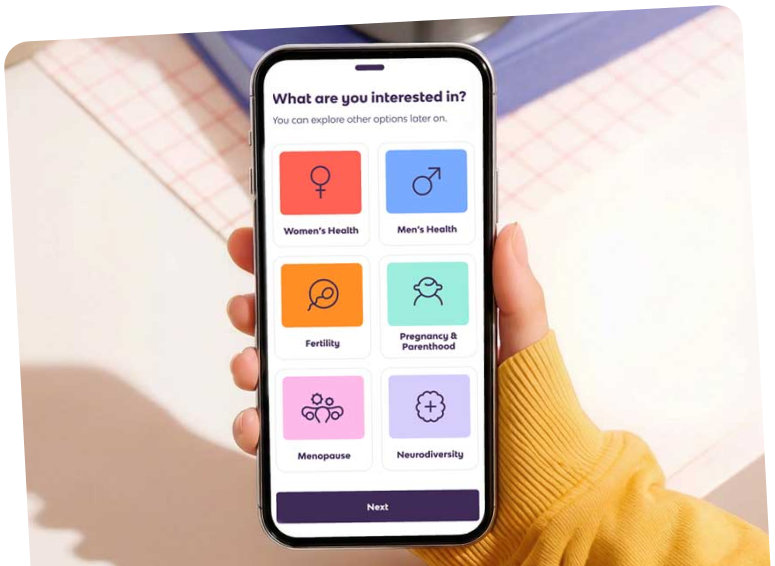
Specialist life-stage support means targeted clinical care for specific health needs that general provision doesn't go deep on, including menopause, fertility, men's health, women's health, pregnancy & parenthood, and neurodiversity. This is a newer category, built on the gap left when an EAP or PMI stops short of ongoing, condition-specific care.

How these benefits usually fit together
A typical benefits package layers statutory provision as the baseline, adds PMI or an EAP for broader coverage, and increasingly includes a specialist layer for the life stages or conditions general provision doesn't reach in depth.
Our employee healthcare guide explains how these pieces typically fit together for a UK employer, and where the gaps tend to show up.
FAQ's
A wellbeing platform is generally self-guided: articles, trackers, and general content. A health benefit that includes clinical support, such as an EAP or PMI, gives employees access to a professional for diagnosis, treatment or ongoing care, not just information.
EAP stands for employee assistance programme — a confidential support line most UK employers offer for short-term counselling and practical advice.
Fringe benefits is another term for employee benefits - the non-salary perks and support an employer provides. Health benefits are one category within this wider group, alongside pensions, life insurance and flexible working.