-1.png?width=600&height=450&name=Untitled%20design%20(8)-1.png)


Employee healthcare benefits for employers
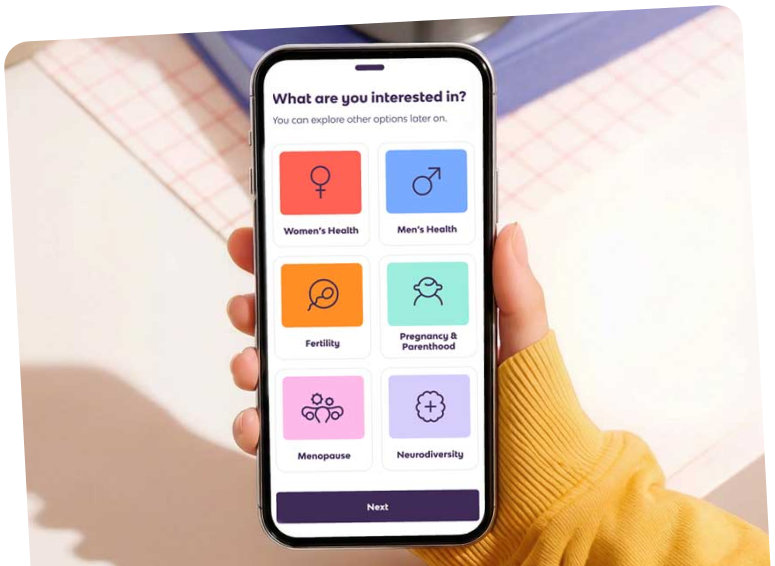
One app, specialist clinicians, and support across every life stage. Peppy works alongside your existing benefits to reach the people the NHS, PMI and a standard EAP leave behind.


What is employee healthcare?
Employee healthcare is the support an employer provides for the physical and mental health of its workforce, from an EAP and private medical insurance to specialist clinical services. Most employers already have some of it in place.
The gap is depth and reach. General provision rarely goes deep on the life stages that quietly drive absence and attrition, and the people who need it most often never engage.
For employers with 500+ staff, employee healthcare is increasingly treated as core infrastructure rather than a perk: something that shows up in retention numbers, sickness absence data, and how competitive an offer looks to candidates.
Employee healthcare sits within the wider category of employee health benefits.
Why employee healthcare benefits matter for retention and productivity
Health-related absence and attrition cost UK employers a lot of money every year, and the businesses seeing the sharpest impact are the ones without proactive healthcare support in place.
HR and Benefits leaders are under pressure to show ROI on any new spend, which means employee healthcare benefits need to do more than exist on paper.
The strongest offers combine clinical access with measurable outcomes: fewer sick days, higher engagement scores, and benefits utilisation data that justifies the investment at renewal.

Better together
What to look for in an employee wellbeing platform
Not every employee wellbeing platform delivers the same thing. When evaluating options, HR and Benefits leaders should look for:
Clinical credibility
Human expert practitioners, not just content libraries or chatbots
Specialist coverage
Support for the health needs that
PMI & EAPs don't typically reach
(menopause, fertility, mental health etc)
Usage data employers can act on
Not just "downloads" but evidence the platform is changing outcomes
A benefit employees actually use
Utilisation and engagement are the real measure of value
| You already have: | Peppy adds: | Your people get: |
|---|---|---|
| EAP | Specialist clinicians | Care they use |
| Private medical insurance | Life-stage support | Faster access |
| NHS access | High engagement levels | Better outcomes |


Traditional Employee Assistance Programs
(EAPs) average a utilisation rate of
10%
Your EAP isn't reaching everyone
Peppy adds the specialist layer that reaches the people yours leaves behind, without replacing anything you already have.
Peppy has high engagement that drives results, with 70% of users still active at 90 days.
FAQ's
Employee healthcare is any employer-provided support for staff physical or mental health, ranging from private medical insurance to specialist platforms covering areas like menopause and fertility.
PMI covers acute and ongoing medical treatment. Employee healthcare platforms typically focus on specialist, preventative support in areas PMI doesn't reach, and are designed to be used alongside existing insurance rather than instead of it.
No. Peppy sits alongside what you already have. Most employers keep their EAP and PMI, and add Peppy as the specialist layer that reaches deeper into specific life stages and conditions.
Specialist, personalised and unlimited menopause, fertility, men's and women's health, pregnancy & parenthood, mental health and neuroinclusion, all in one app.
Look for clinical credibility, specialist coverage beyond generic wellbeing content, fast access to practitioners, and reporting that shows actual usage and outcomes.