

UK employers now carry legal duties across four areas of employee health: neurodiversity, women's health, pregnancy and parenthood, and menopause. Those duties come from more than one law, and many already apply.
Here's which laws matter, what each area requires, and what to have in place.
Which laws cover employee health?
Three sets of rules do most of the work:
- The Equality Act 2010. It protects employees whose condition meets the legal definition of disability: a physical or mental impairment with a substantial and long-term effect on day-to-day activities. Where it applies, employers must make reasonable adjustments and must not discriminate.
- Flexible working rules. Employers must fairly consider requests, including those made for health reasons.
- The Employment Rights Act 2025. It adds new rights on parental leave, dismissal protection and menopause support, phased in across 2026 and 2027. Our Employment Rights Act hub covers the wider changes.
The Equality Act does the heaviest lifting. There's no fixed list of qualifying conditions, so what matters is how a condition affects someone, not its name.
What applies now and what changes in 2027
|
Area |
In force now |
From 2027 |
|---|---|---|
|
Neurodiversity |
Reasonable adjustments and protection from discrimination, with or without a diagnosis |
No change |
|
Women's health |
Adjustments where conditions like endometriosis qualify as a disability |
No change |
|
Pregnancy and parenthood |
Day-one paternity leave and unpaid parental leave |
Protection from dismissal during pregnancy, maternity leave and the six months after return |
|
Menopause |
Equality Act duties where symptoms qualify as a disability |
Employers with 250+ employees must publish how they support employees through menopause |
Neurodiversity: protection applies without a diagnosis
ADHD (attention deficit hyperactivity disorder), autism, dyslexia and dyspraxia can qualify as a disability under the Equality Act 2010.
A formal diagnosis isn't required. If someone tells their manager they think they're neurodivergent, the duty to consider adjustments can apply straight away. Around 1 in 7 people are neurodivergent, according to Acas, so this is a common request, not a rare one.
Women's health: endometriosis can count as a disability
Endometriosis and premenstrual dysphoric disorder (PMDD) are judged against the same threshold as any other condition. Where they qualify, employers must make reasonable adjustments.
Many managers don't know this. That gap is where tribunal risk sits. Read more in The hidden legal risk in ignoring women's health at work.
Pregnancy and parenthood: stronger rights from day one
Day-one paternity leave and unpaid parental leave have applied since April 2026. From 2027, employees are protected from dismissal during pregnancy, maternity leave and the six months after they return.
Policies written before 2026 are likely out of date. Our parental leave blog covers the detail.
Menopause: support becomes a public commitment
Menopause symptoms can already meet the Equality Act definition of disability. From 2027, larger employers will also have to publish how they support employees through menopause, so employees and candidates can see it. Our Menopause Action Plans guide explains what to include.
Where EAP and PMI usually stop
Most employers rely on an employee assistance programme (EAP) and private medical insurance (PMI). Both usually stop short here:
- EAPs offer short-term counselling, not access to specialist clinicians
- PMI covers acute treatment, and usually excludes routine pregnancy and ongoing care for chronic conditions such as endometriosis or neurodivergence
Those gaps show up as sickness absence, presenteeism and people leaving. 1 in 4 women consider leaving work because of menopause, and 1 in 10 do.
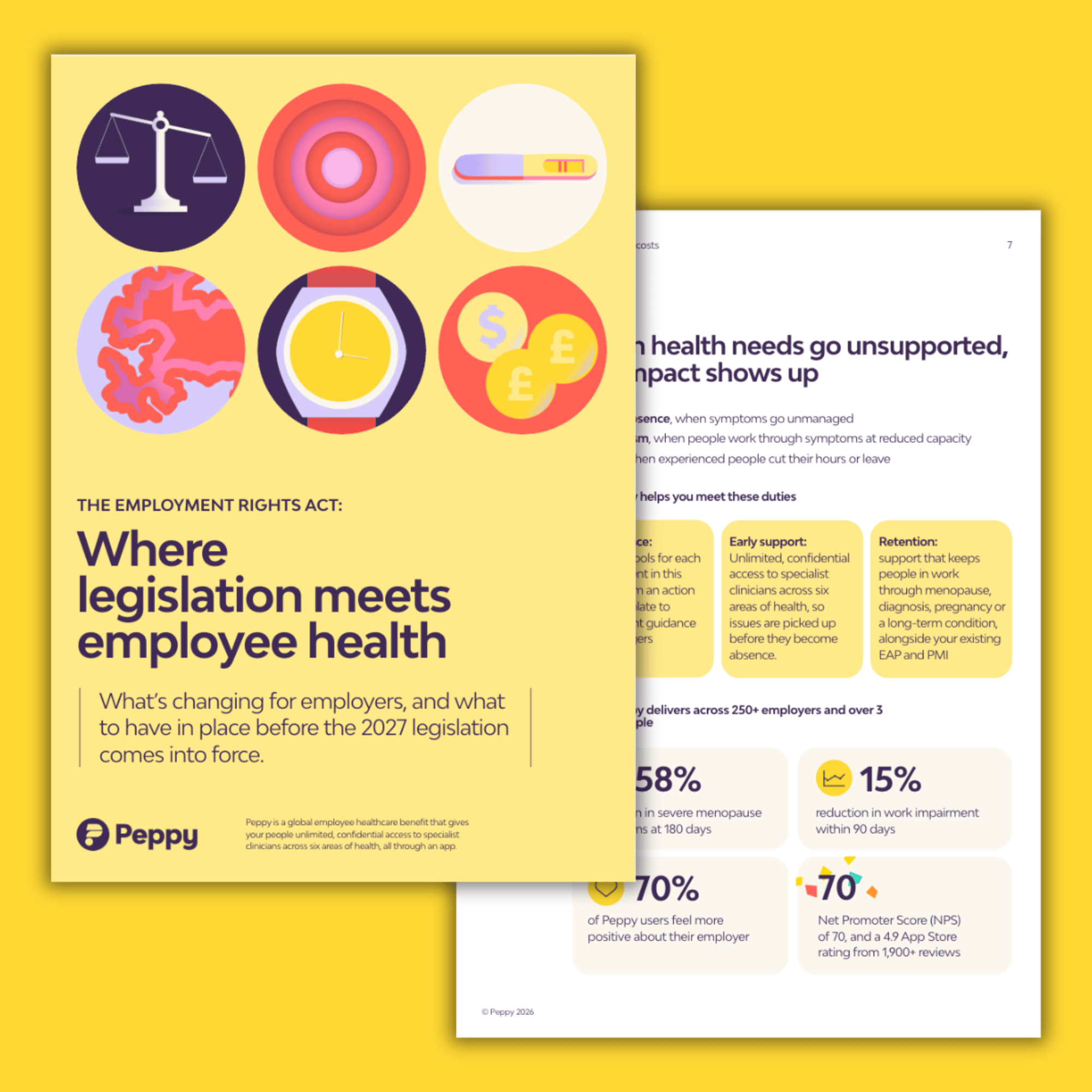
Where legislation meets employee health What the law requires across all four areas, what changes in 2027, and where your current support stops.
Download the guideWhat to have in place
- Managers who can agree adjustments without asking for a diagnosis
- Policies that reflect day-one leave rights and the 2027 dismissal protections
- A flexible working process that covers health-related requests
- Specialist clinical support across all four areas, alongside your EAP and PMI
Frequently asked questions
What legislation covers employee health in the UK?
The main laws are the Equality Act 2010, which covers disability, reasonable adjustments and discrimination, and the Employment Rights Act 2025, which adds new rights on parental leave, dismissal protection and menopause support. Flexible working rules also apply to health-related requests.
Do neurodivergent employees need a diagnosis to be protected?
No. ADHD, autism, dyslexia and dyspraxia can qualify as a disability under the Equality Act 2010, and a formal diagnosis isn't required for protection to apply. Employers should consider reasonable adjustments as soon as an employee raises a need.
Is endometriosis a disability under the Equality Act?
It can be. Endometriosis and PMDD are judged against the same threshold as any other condition. Where a condition has a substantial and long-term effect on someone's day-to-day activities, employers must make reasonable adjustments.
Do these duties apply to smaller employers?
Yes, most do. Equality Act duties and day-one leave rights apply to employers of every size. The requirement to publish menopause support from 2027 applies to employers with 250 or more employees.
What counts as a reasonable adjustment?
Any change that reduces the disadvantage an employee faces because of their condition. Common examples include flexible hours, extra breaks, changes to workload and access to specialist health support. What's reasonable depends on the employer's size, resources and how effective the change would be.
Does my EAP or PMI cover these areas?
Partly. EAPs typically offer short-term counselling, and PMI typically covers acute treatment. Most plans exclude routine pregnancy and ongoing care for chronic conditions, so specialist support for menopause, neurodiversity and women's health often falls outside both. Check your own policies, as cover varies by provider.
This article gives general information about UK employment law as of November 2026. It isn't legal advice.