


Around 1 in 7 people in the UK are neurodivergent. In a workforce of 5,000, that's roughly 715 employees. Supporting them well means offering help before, during and after diagnosis, because most neurodivergent people at work don't have one.
This guide covers what employers need to know, where current benefits fall short, and what good support looks like.
What is neurodiversity?
Neurodiversity describes the natural variation in how people's brains process information, learn and communicate. It's an umbrella term covering conditions including ADHD (attention deficit hyperactivity disorder), autism, dyslexia, dyspraxia, dyscalculia and Tourette's syndrome.
Neurodivergent employees bring strengths employers value. In a UK study by Birkbeck, University of London, over 80% of respondents named hyperfocus as a strength, with 78% citing creativity and 75% innovative thinking.
Why diagnosis-led support leaves people behind
Many benefits only start once someone has a diagnosis. For most neurodivergent employees, that's a long way off.
NHS waits for an ADHD assessment commonly run into years. A private diagnosis costs £1,000 to £5,000 and covers the assessment only, not the support afterwards. And 90% of middle-aged and older autistic adults in the UK have never been diagnosed.
Disclosure is another barrier. 65% of neurodivergent employees fear discrimination from management, so many never tell HR what they need.
Without support, that gap shows up as absence, presenteeism and attrition. 58% of neurodivergent employees say their benefits package is inadequate, and 62% would leave for an employer with more inclusive benefits. At a national level, NHS England's Independent ADHD Taskforce estimates that unsupported ADHD costs the UK at least £17 billion a year, much of it avoidable.
Where EAP and PMI fall short
Most employers already offer an employee assistance programme (EAP) or private medical insurance (PMI). Both have limits for neurodivergent employees.
- EAPs offer general wellbeing and counselling support, but rarely include neurodiversity specialists, screening or a route to assessment.
- PMI sometimes covers an ADHD or autism assessment, but cover usually ends at diagnosis. Support while someone waits, and after they're diagnosed, is rarely included.
That leaves gaps at the points employees need help most.
Your legal duties as an employer
Under the Equality Act 2010, many neurodivergent conditions can count as a disability. Employers then have a duty to make reasonable adjustments and prevent discrimination.
That duty doesn't depend on a formal diagnosis. It applies when a condition meets the legal definition of disability and the employer knows, or could reasonably be expected to know, about it. Waiting for a diagnosis before acting can leave employees unsupported and expose the business to risk.
What good neurodiversity support looks like
Effective support works at every stage, with or without a diagnosis:
- Before diagnosis: confidential access to specialists who can talk through what someone is experiencing and suggest practical strategies for work.
- Assessment: a fast, clinically sound route to diagnosis for those who want one.
- After diagnosis: ongoing specialist support, including treatment where needed.
- Manager guidance: clear materials so managers know how to respond and where to signpost.
How Peppy supports neurodivergent employees
Peppy gives employees unlimited, confidential access to specialist neurodiversity clinicians through one app. Support starts with no diagnosis needed, through a screening tool, one-to-one consultations and asynchronous chat for people who prefer to process at their own pace.
For employees who want an assessment, Peppy partners with Psychiatry UK to offer ADHD and autism appointments within 10 days, with no waiting list for treatment.
Neurodiversity sits alongside Peppy's support for menopause, fertility, men's health, women's health, and pregnancy and parenthood. Peppy supports 250+ employers in 20+ countries and over 3 million people.
Get the neurodiversity toolkit
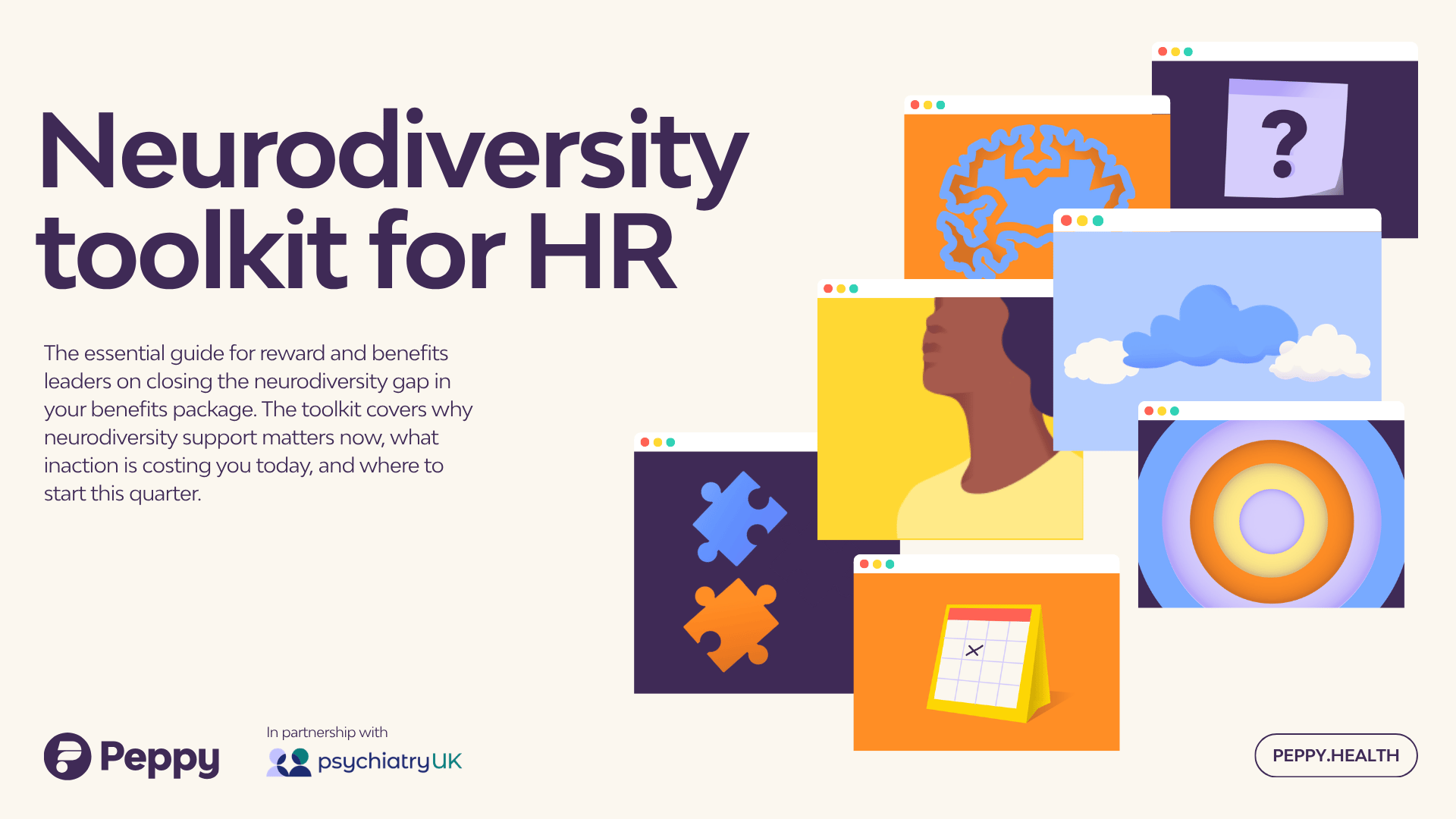
Our free toolkit, created with Psychiatry UK, covers the business case, your legal obligations, a side-by-side comparison of Peppy, EAP and PMI, and a 60-day rollout plan.
Frequently asked questions
What is neurodiversity in the workplace?
Neurodiversity in the workplace means recognising that people think, learn and process information differently, and shaping support around that. It covers conditions including ADHD, autism, dyslexia and dyspraxia.
How many employees are neurodivergent?
Around 1 in 7 people in the UK are neurodivergent, roughly 15% of the population. In a workforce of 5,000, that's around 715 people, many without a formal diagnosis.
Does private medical insurance cover ADHD and autism assessments?
Some private medical insurance (PMI) policies cover neurodiversity assessments, but cover usually ends at diagnosis. Employees are often left without support while they wait, or once they've been diagnosed.
What's the difference between an EAP and specialist neurodiversity support?
An employee assistance programme (EAP) offers general wellbeing and counselling support. Specialist neurodiversity support gives access to clinicians trained in conditions like ADHD and autism, plus screening, assessment and ongoing care.
Does an employee need a diagnosis to get reasonable adjustments?
No. Under the Equality Act 2010, the duty to make reasonable adjustments can apply if an employer knows, or could reasonably be expected to know, that an employee has a disability. A formal diagnosis isn't required.
How does Peppy support neurodivergent employees?
Peppy gives employees unlimited, confidential access to specialist neurodiversity clinicians through an app, before, during and after diagnosis. Through Peppy's partnership with Psychiatry UK, employees can also access ADHD and autism assessments within 10 days.